
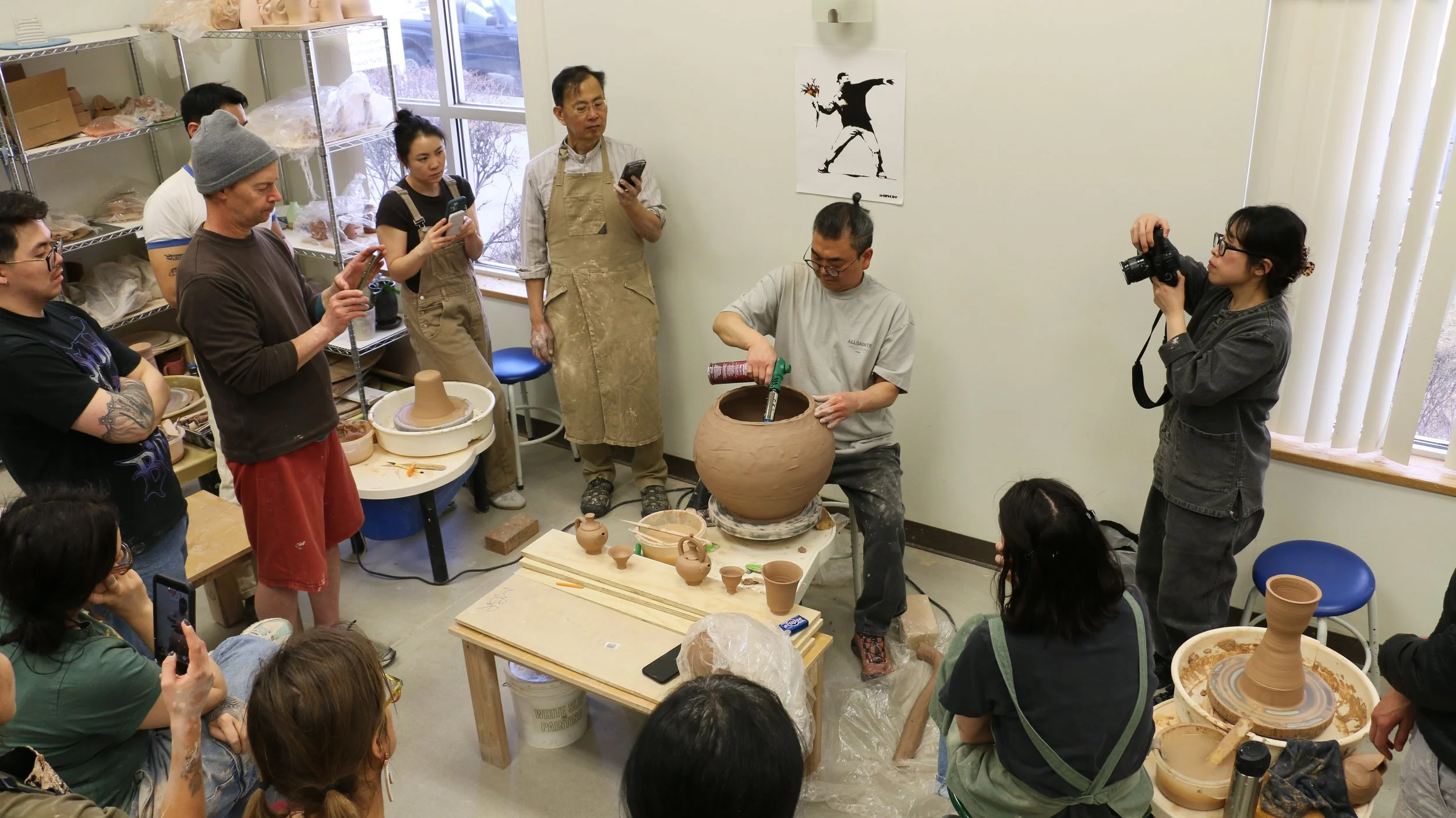
Interpreted by Tommy of Studio Tomi
Note: This transcript has been lightly edited for clarity and length. Bracketed text [ ] indicates notable changes, additions, or clarifications made during editing.
Luna: I understand that Kwangju has a long history of ceramics and is a hub for the arts, so has pottery and the arts always been a part of your life? How did you find your interest in ceramics?
Tommy: The center in Korea for ceramics is actually Icheon. That’s where Teacher works right now. He started ceramics in high school, and he first went to an art high school and then discovered ceramics and thought it was quite amazing. It was something he was quite interested in because it was very physical. He got interested in that and kept at it and then in college and so forth.
Luna: So going off that, I was researching your background and story, and I was also looking at other interviews. I saw that you said the first time you saw Onggi wasthis master making this big Onggi, and was that also high school, or was that later?
Tommy: In the second year of college was actually when he saw it, in a throwing competition he was attending as a competitor. At the opening ceremony there were two Onggi masters that came by, and created Onggi for the opening ceremony. It was his first time seeing it being made. He was enamored because it was huge and it was an approach to clay that he had never seen before. That was a turning point for him in his career.
Luna: Was the physical attraction you mention from your original attraction [to clay] also for [Onggi]?
Tommy: When he watched Onggi being made, it wasn’t really about the physical part of it. It was that the masters were in their 60s and 70s, and so freely manipulating this clay, and so much of it at once. They were going quite slowly and meticulously. So it wasn’t this brute force method; it was really about the technique and that was what enamored him to the Onggi technique. The way that they were so in tune with the properties of the clay and how to manipulate it looked like something that could only be achievable by people who have really dedicated their lives to a specific medium. That’s what he was striving for and attracted him to Onggi.
Luna: That’s incredible. If that’s the case, how did/do you decide to dedicate your time to your Onggi versus smaller works?
Tommy: There are phases in life, where there are things one has to juggle. In the early days, it was quite a lot of smaller stuff, because it was kind of all encompassed with wheel throwing, and then once he discovered Onggi, it was another expansion in his tools, his arsenal, being able to make much larger items. However, in his younger days, with requirements about survival, he had to really dedicate a lot of his time to functional ware, smaller pieces, to make a living, because that was his job. Even during those days, he spent a lot of time to make sure to dedicate time to his shows, his solo shows, to make sure he had an avenue to creatively express himself, other than just functional ware. Soon, little by little, the needle points the other way, where at some point, it’s functional [and now] it’s “my art.” It became kind of melted into his own, and it’s now inseparable–his functional ware that he makes is his art, as well as his art that’s not functional.
Luna: This is great, because one of my other questions was about how I was reading that demand for Onggi is diminishing with changes in Korean lifestyle and products that are available. So how do you hope or want Onggi to be perceived in the future?
Tommy: The passage of time is inevitable, [as is] change. There is always going to be change, and with the fridges, specifically kimchi fridges in Korea, the usage of the Onggi in the modern family home has diminished a lot. There are still people using it to this day, because the product, the food [kimchi], that you make does taste different when you use Onggi. However, he doesn’t want to be stuck in the past. He’s not saying we should never forget [Onggi], but he thinks that there should always be respect for the tradition. Tradition should be carried out in some form or another. He understands that the usage will become less and less, [but] that there will always be someone continuing the legacy. Even him going out to the States or doing international tours of the demos and classes is part of how to kind of immortalize [this] Korean tradition. More and more people outside of Korea are becoming aware of this tradition as well. He’s going to teach his son as well.
Luna: I guess this isn’t fully related to ceramics, but I was wondering about what you are wearing. Is it traditional for Korean potters, or is it traditional Korean clothing?
Tommy: So this isn’t the traditional Hanbok, Hanbok being the Korean outfit. It is a modernized casual version of a Korean Hanbok. It was made to be more approachable in modern times, society, to be more freely and casually worn in the current era. He has chosen to wear this for himself, especially outside on these tours (he wears them in Korea, as well), because he is providing and showcasing such a tradition that’s so purely Korean and uniquely Korean. He wants to make sure his dress reflects that–that he is dressing appropriately. He’s very thankful that it’s been received quite positively, and that people are very curious and interested about it. He doesn’t wear it every day, but there is a point he started wearing it more often, and now when he travels abroad, he makes sure he definitely brings it along as a statement piece during his tour internationally.
Luna: How did you develop your style? I read that you built a little bit off of the traditions from Kwangju and Joseon [dynasty] traditions, and that you integrate those. So is that part of how you developed your [ceramic] style?
Tommy: Creating the vessel itself is rooted in traditional Korean wheel throwing and Onggi techniques. However, the way that he dresses and decorates his pieces is with the practice of Buncheong, a traditional art form that was very popular in the 13th to 15th centuries for about 200 years. It’s right in between the Celadon era and the Porcelain era. The act of putting white slip onto dark clay was quite a free form art, whereas porcelain was such a strict [form]–you have to have rules, you have to be perfect. Buncheong is quite free form, and free spirited. There’s brushing involved, and if you look at the artifacts back from that era, for lack of a better word, there’s a lot of free spirit, expression, creative expression of the Buncheong ware. He really gets a lot of influence from that, but he likes to take that a little further by expressing even more creative energy into his Buncheong ware. [He does so by] using really rough clay, maybe even rougher slip, and really combining textures and even almost like flaws and textures into his work. He’s still continuing that work, but he wants to do all of that–all of that is kind of taking all three traditional techniques and forms, and putting his style as Kwak Kyung Tae on it.
Luna: This was great, thank you so much.
Tommy/Kwak: Thank you.
Learn more about Kwak Kyung Tae and Studio Tomi.